Choosing between GWO Basic Safety Training and GWO Basic Technical Training is one of the most common questions for anyone entering the wind energy industry. The short answer is straightforward: take GWO BST first. But understanding why — and knowing exactly when BTT fits into your pathway — makes the difference between a well-planned career launch and a costly misstep. This guide breaks down both qualifications in detail, compares their purpose and audience, and gives you scenario-based guidance so you can map the right training sequence to your specific career goal.
GWO BST vs BTT: Understanding the Difference
Gwo btt vs bst — Before weighing up which course to take first, it helps to understand what each qualification is actually designed to do. These are not competing courses — they sit at different layers of the Global Wind Organisation training framework and are designed to be taken in sequence.
What Is GWO Basic Safety Training (BST)?
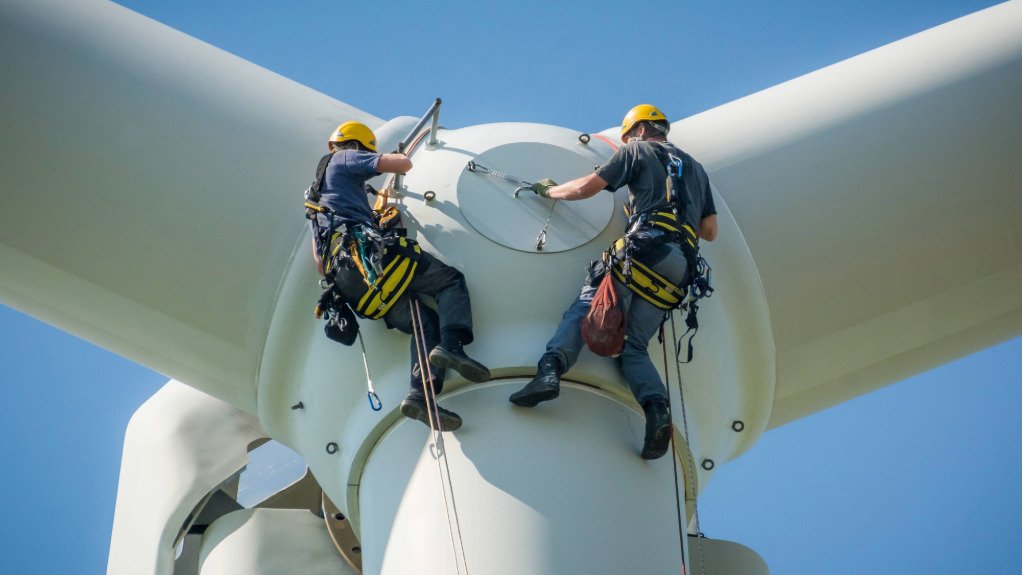
GWO Basic Safety Training is the industry’s universal entry-level safety standard for anyone who accesses wind turbines. Developed by the Global Wind Organisation — an industry body formed by major turbine manufacturers and wind farm operators — BST standardises safety competencies across the global wind sector so that employers everywhere can rely on consistent skills and emergency response capability.
The BST standard covers four core modules:
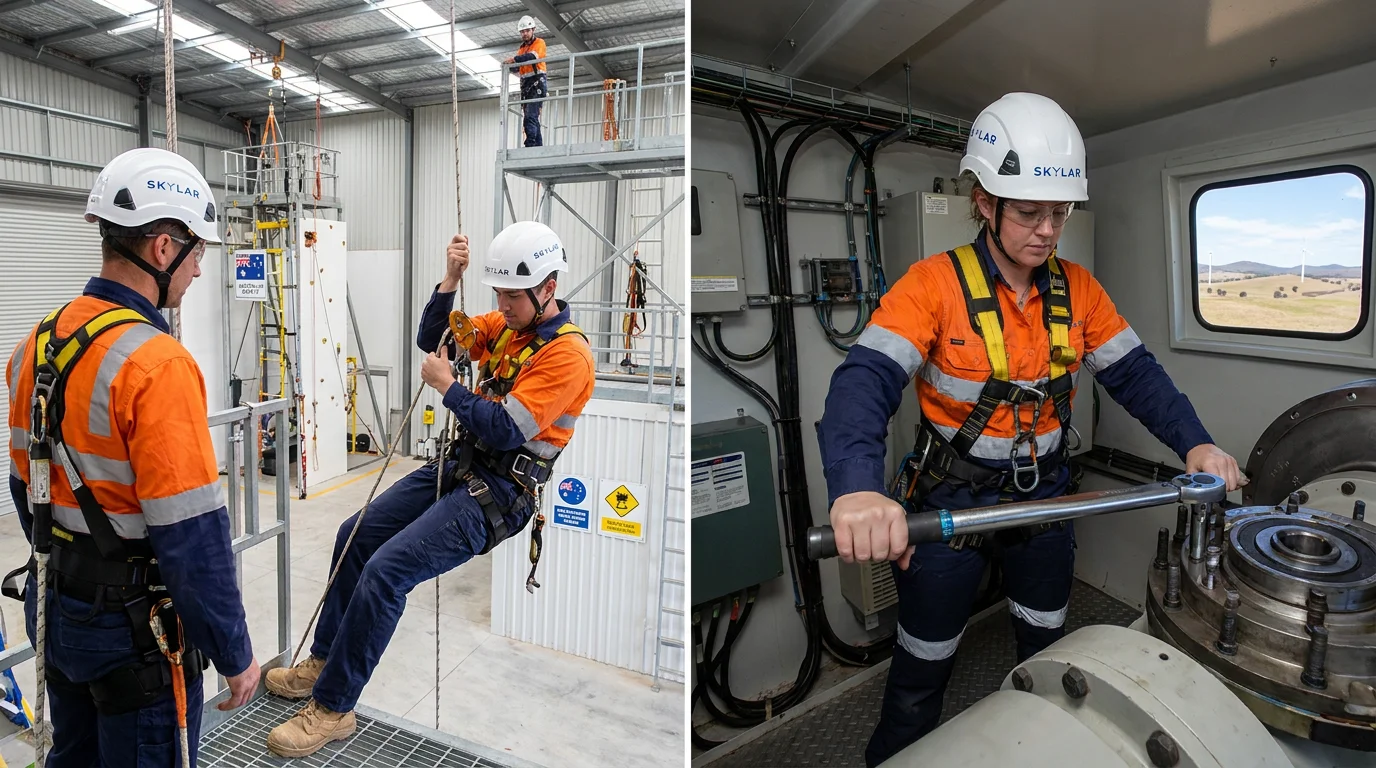
- Working at Heights — safe climbing technique, fall protection systems, and rescue procedures at elevation
- Manual Handling — correct lifting and load management to reduce musculoskeletal injury risk
- Fire Awareness — hazard identification, extinguisher use, and turbine evacuation procedures
- First Aid — emergency response, CPR, and basic trauma management in a turbine-specific context
For offshore roles, a fifth module — Sea Survival — is also included, covering transfer procedures, immersion suits, and water rescue.
BST is widely recognised as the baseline access requirement across the global wind industry. Employers — from onshore wind farm operators to offshore installation contractors — commonly treat a current GWO BST certificate as the minimum standard before any worker sets foot on site.
What Is GWO Basic Technical Training (BTT)?
GWO Basic Technical Training takes a fundamentally different approach. Rather than focusing on safety and emergency response, BTT addresses the mechanical, electrical, and hydraulic systems inside modern wind turbines. According to the GWO standard itself, BTT is designed to prepare participants for further company-specific or OEM (Original Equipment Manufacturer — the turbine’s original maker) technical training by giving them the foundational knowledge needed to perform basic technical tasks safely and competently.
The three content pillars of BTT are:
- Mechanical — turbine components, torqueing and bolting procedures, correct tool use, and component handling
- Electrical — basic electrical theory, safe working practices around live systems, measurement techniques, and isolation procedures
- Hydraulic — hydraulic principles, system components, operational logic, and safe work practices
BTT is not a general site-access requirement. It is a role-specific technical qualification aimed at people who will actively work on turbine systems — not simply visit or inspect them.
How They Fit Together
Think of BST as the foundation layer and BTT as the technical layer built on top of it. BST ensures every person on site can respond to emergencies, work safely at height, and handle the physical demands of turbine environments. BTT then equips technicians with the system-level knowledge to perform maintenance, fault-finding, and installation work. Together, they form a powerful and complementary qualification set — but the sequence matters.
Who Each Course Is Designed For
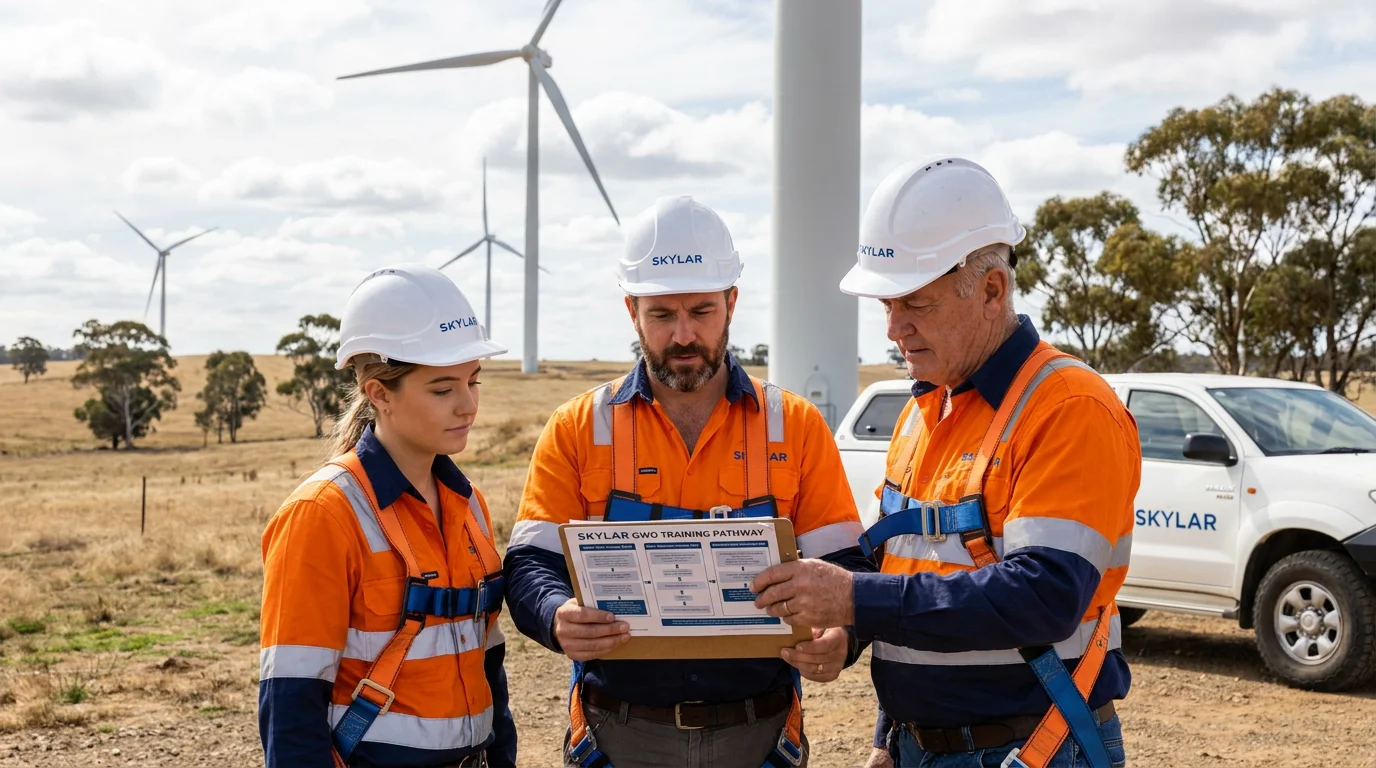
Understanding the target audience for each course is the clearest way to determine which one belongs first in your training plan. The two qualifications serve genuinely different groups of people, even though there is significant overlap among those who will eventually need both.
Audience Overview
The table below summarises the key distinctions at a glance:
| Aspect | GWO BST | GWO BTT |
|---|---|---|
| Primary purpose | Core safety and emergency response for turbine environments | Technical fundamentals for mechanical, electrical and hydraulic systems |
| Typical participants | New entrants, experienced technicians, contractors, site visitors, marine crew | Technicians and trainees performing hands-on maintenance, installation or troubleshooting |
| Industry expectation | Widely treated as mandatory baseline for site access and advanced GWO modules | Preferred or required for technical roles; not universal for all site workers |
| Prior experience needed | No wind industry experience required | Assumes the learner will work in a turbine environment where BST-level safety knowledge applies |
Who Should Prioritise BST
GWO BST is the right starting point for a broad range of people:
- New entrants to the wind industry with no prior turbine experience
- Tradespeople from other sectors transitioning into wind
- Contractors and subcontractors who need site access for non-technical work
- Health, safety, and environment (HSE) professionals conducting site inspections
- Original equipment manufacturer (OEM) representatives visiting turbines for assessments or audits
- Anyone who needs to demonstrate a minimum safety standard to a wind farm operator
Who Should Add BTT
GWO BTT is specifically valuable for:
- Wind turbine technicians who will perform scheduled maintenance or corrective repairs
- Electrical or mechanical tradespeople moving into turbine-specific technical roles
- Trainees preparing for OEM or company-specific technical induction programmes
- Anyone targeting long-term employment in turbine operations and maintenance (O&M)
The key distinction is simple: if you will be on turbines, you need BST. If you will be working on turbine systems, you need BTT as well.
Which Course Should You Take First — and Why
The answer to the core question is clear: take GWO Basic Safety Training first. This is not simply a matter of convention — it reflects the logical structure of the GWO framework, the practical realities of site access, and the way advanced training pathways are built.
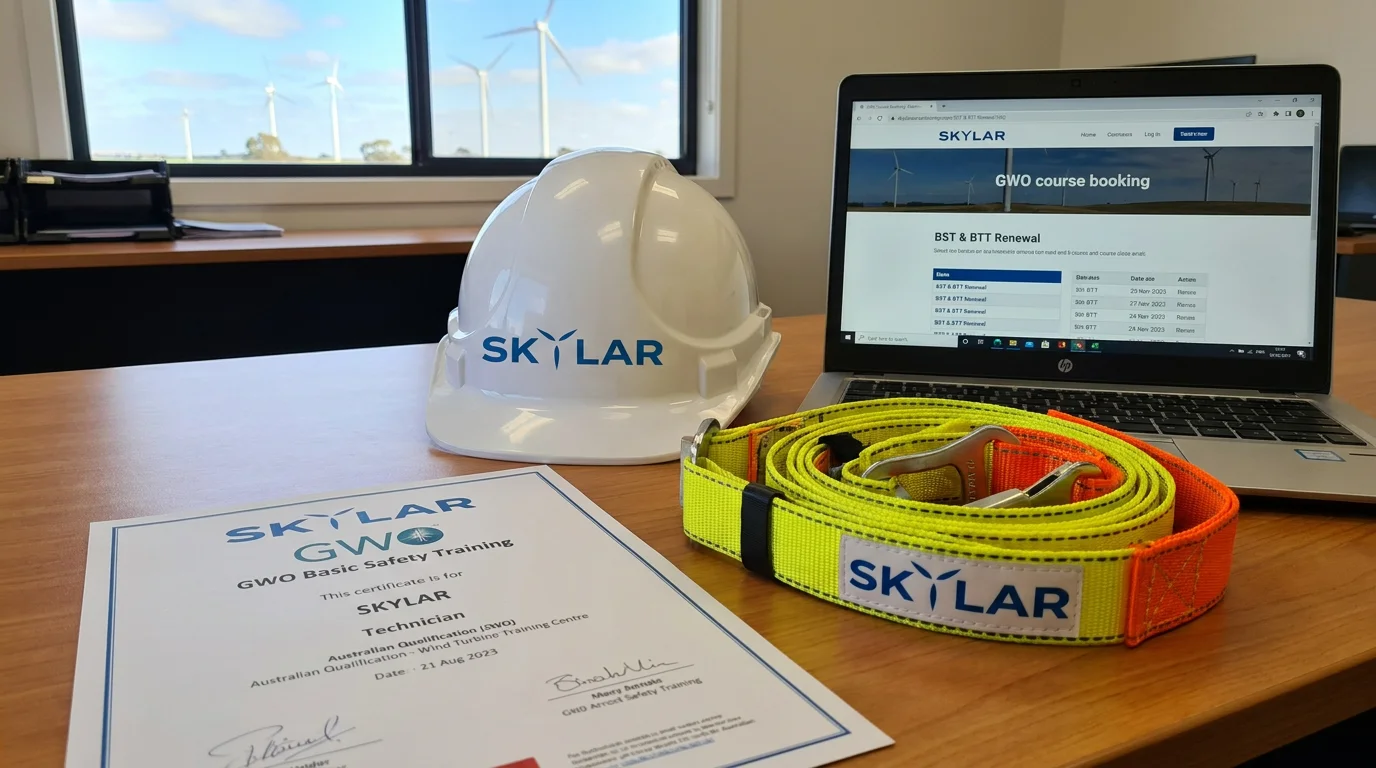
BST Is the Industry’s Baseline Access Requirement
Across the global wind industry, GWO BST is recognised as the primary entry requirement for wind technician roles and turbine site access. Without a current BST certificate, most wind farm operators will not permit access to the turbine environment — regardless of your technical qualifications or trade background. This means that even if BTT is ultimately your goal, you cannot meaningfully apply those technical skills on a real site without BST in place first.
BST Is a Prerequisite for Advanced GWO Modules
The GWO framework is tiered by design. Many advanced modules — including Advanced Rescue Training and Enhanced First Aid — explicitly require a valid BST certificate before enrolment. Taking BTT before BST would leave you unable to progress to these higher-level qualifications without returning to complete the foundational course first.
The Recommended Training Sequence
For anyone pursuing a career as a wind turbine technician, the industry-aligned pathway looks like this:
- GWO Basic Safety Training (BST) — establishes your safety baseline, enables site access, and satisfies the prerequisite requirement for advanced GWO modules
- GWO Basic Technical Training (BTT) — builds your mechanical, electrical, and hydraulic knowledge, preparing you for Original Equipment Manufacturer (OEM) or company-specific technical training
- Advanced GWO modules — such as Advanced Rescue Training, Enhanced First Aid, or offshore-specific qualifications, depending on your role and employer requirements
This sequence aligns with global industry expectations and the way the Global Wind Organisation structures its standards framework. It also reflects the practical reality that safety competence must precede technical specialisation — you need to know how to work safely in the environment before you start learning how to work on the equipment within it.
Scenario-Based Guidance: Matching the Course to Your Career Goal
Every learner comes to GWO training with a different background and a different destination. The scenarios below are designed to help you self-identify the right starting point and understand exactly when BTT adds meaningful value to your profile.
Scenario 1: New Entrant to Wind Energy
You have no prior wind industry experience and want to become a wind turbine technician. You are starting from scratch and want to build a qualification profile that gets you hired.
Recommended path: Start with GWO BST immediately. It is the recognised entry requirement for wind technician roles and the credential that unlocks site access. Once BST is complete, enrol in GWO BTT to build your technical profile across mechanical, electrical, and hydraulic systems. This BST + BTT combination is a strong, industry-aligned foundation for job applications and positions you well for employer-provided Original Equipment Manufacturer (OEM) technical training once you are hired.
Scenario 2: Tradesperson Switching Sectors
You hold electrical or mechanical trade qualifications and are moving from construction, mining, or manufacturing into the wind industry. You already have strong technical skills — you just need to contextualise them for turbines.
Recommended path: You still need GWO BST first. Your trade background does not substitute for wind-specific safety training, and most wind farm operators will require a current BST certificate before granting site access. Once BST is in place, your trade experience will give you a significant head start in BTT — the course is designed to contextualise existing technical knowledge within turbine-specific systems, hazards, and isolation procedures. The combination of your trade background plus BST and BTT is a highly competitive profile for technical roles.
Scenario 3: Occasional Site Visitor
You will visit turbines periodically — perhaps as an HSE professional, project manager, OEM (Original Equipment Manufacturer) representative, or site inspector — but you will not be performing hands-on maintenance or troubleshooting.
Recommended path: GWO BST alone is usually sufficient for your needs. Your primary risk exposure is safety-related — working at height, emergency response, manual handling — rather than technical. BST satisfies the access requirement and demonstrates the safety competence that wind farm operators expect from all site visitors. BTT is not essential unless your role expands into active technical work.
Scenario 4: Targeting Broad Onshore and Offshore Employability
You want maximum flexibility — the ability to work across onshore and offshore projects, with multiple operators, in both Australian and international markets.
Recommended path: Build your qualifications in the full recommended sequence: BST first, then BTT, then advanced modules such as Advanced Rescue Training as your career develops. This pathway aligns with global industry practice and gives you the broadest possible credential set. Offshore roles in particular often require not just BST but also the Sea Survival module and additional advanced qualifications — all of which build on a current BST certificate as their foundation.
Certificate Validity and Renewal: What to Plan For
Understanding how long your GWO certificates remain valid is an essential part of career planning. The renewal requirements for BST and BTT differ significantly, and factoring them into your training budget and schedule will save you from unexpected gaps in certification.
GWO BST Certificate Validity
GWO BST certificates are valid for 24 months from the date of completion. At the end of this two-year period, you must complete a BST Refresher (BSTR) to maintain your current status. The refresher is designed to reinforce and update the core safety competencies from the initial course, keeping your skills aligned with evolving turbine technology, updated procedures, and any changes to the GWO standard itself.
This two-year renewal cycle has practical implications for your career planning:
- Schedule your BSTR well before your certificate expires — many employers will not accept a certificate within the final weeks of its validity period
- If you allow your BST to lapse, you may need to complete the full initial course again rather than a refresher, which takes more time and costs more
- Keep a record of your certificate expiry date and set a reminder at the 18-month mark to allow time to book and complete your refresher
GWO BTT Certificate Validity
GWO BTT currently has no formal expiry date under the GWO framework. Unlike BST, there is no mandated refresher cycle built into the standard. However, this does not mean your BTT qualification is a permanent, maintenance-free credential in the Australian context.
Under Australia’s work health and safety legislation, a Person Conducting a Business or Undertaking (PCBU) — in plain terms, any business or organisation responsible for carrying out work, such as wind farm operators and maintenance contractors — is required to ensure workers are adequately trained and competent for the specific tasks they perform. This obligation does not disappear simply because GWO has not set a formal BTT expiry date. In practice, this means:
- Employers may require periodic internal refreshers or competency reassessments for technical roles
- Moving to a new turbine technology platform — for example, from one Original Equipment Manufacturer’s (OEM) equipment to another — may prompt employers to require updated BTT or supplementary technical training
- Keeping your BTT training current strengthens your employability, even in the absence of a mandated renewal cycle
Practical Planning Summary
- BST: Plan to renew every 2 years via the BSTR refresher — this is non-negotiable for maintaining site access
- BTT: No formal GWO expiry, but expect employers to require current and relevant technical competence, particularly when working across different turbine types or technologies
Start Your GWO Training Pathway with Skylar Education
For anyone serious about building a career in the Australian wind industry, choosing the right training provider is just as important as choosing the right course. We deliver both GWO Basic Safety Training and GWO Basic Technical Training as a Registered Training Organisation (RTO 21647), combining national VET compliance with GWO-aligned course content and delivery.
Why Train with Us
Our training is built around the practical realities of the Australian wind industry:
- RTO 21647 accreditation — regulated under the national VET Quality Framework, ensuring assessment integrity, consistent quality, and recognised qualifications
- GWO-aligned delivery — our course content and assessment methods are structured to meet the Global Wind Organisation (GWO) standards recognised by wind farm owners and Original Equipment Manufacturers (OEMs) worldwide
- National training centres — we operate across Victoria, Western Australia, Queensland, South Australia, and New South Wales, making it straightforward to access training regardless of where you are based
- On-site wind farm delivery — for operators and contractors who need to train teams at their facilities, we offer on-site delivery that minimises travel time and keeps your workforce on location
Your Next Step
Whether you are a new entrant mapping out your first qualifications or an experienced tradesperson adding wind-specific credentials to your profile, the pathway is the same: GWO BST first, then GWO BTT to build your technical capability.
Our GWO Basic Technical Training course is designed for exactly this moment — when you have your safety foundation in place and you are ready to develop the mechanical, electrical, and hydraulic knowledge that technical roles demand. The course is delivered by industry-experienced trainers, structured around the GWO BTT standard, and designed to prepare you for the OEM and company-specific technical training that follows in most employer onboarding programmes.
If you are ready to take the next step in your wind industry career, explore our GWO Basic Technical Training course and find a delivery date and location that works for you. Our team is also available to help you plan your full training pathway — from initial BST through to advanced modules — so you can build your qualifications in the right order, at the right pace, for the career you are targeting.
Ready to take the next step?
Global Wind Organisation Basic Safety Training (BST) Initial — explore how we can help you get started.